Home Loan for Government Employees: Complete Guide 2026
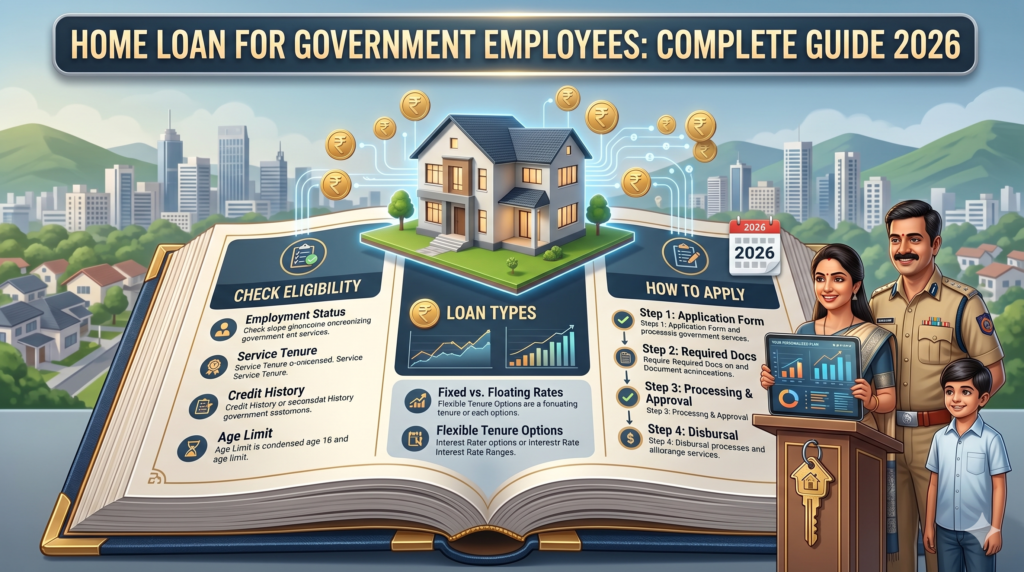
Home Loan for Government Employees: Complete Guide 2026
Home Loan for Government Employees: Complete Guide 2026
Introduction
Government employees are among the most preferred borrowers for banks and housing finance companies in India. Due to stable employment, regular salary, pension benefits, and lower default risk, banks often provide special concessions and faster approvals to government employees.
Whether you work in the Central Government, State Government, Defence Services, Railways, PSU, Ordnance Factories, Public Sector Banks, or Autonomous Bodies, you may qualify for preferential home loan schemes that can save lakhs of rupees over the life of your loan.
This guide covers everything a government employee should know before taking a home loan.
Why Banks Prefer Government Employees
Banks consider government employees low-risk borrowers. This results in significant benefits, including lower interest rates, higher loan eligibility, reduced processing fees, longer repayment tenures, and faster loan approvals.
Ensures a highly stable career with a significantly lower probability of job loss.
Wages are consistently credited directly to bank accounts, making verification easy.
Assured pensions and retirement funds ensure long-term financial security.
Historical data shows a demonstrably better repayment history overall.
Who Qualifies as a Government Employee?
Most major banks and housing finance companies extend their exclusive government employee benefits to staff working in the following sectors.
Central & State Government
- Central Govt Employees
- State Govt & Secretariat Staff
- Railways & Postal Department
- Income Tax & CPWD
- Teachers & Police Personnel
PSU & Autonomous Bodies
- BHEL, ONGC, SAIL
- GAIL, NTPC, HAL, BEL
- Ordnance Factories
- Municipal Employees
Uniformed Services
- Army, Navy, Air Force
- Coast Guard
- CAPF
- Defence Civilian Employees
Home Loan Eligibility for Government Employees
Age & Employment Status
- Age Criteria: Minimum age is generally 21 years. Maximum age at maturity is 70–75 years. Some banks allow repayment beyond retirement if pension income is available.
- Employment Status: Permanent employees receive the highest eligibility. Probationary employees may receive limited eligibility.
Credit Score Requirement
Although banks approve loans for lower scores, the best interest rates are generally available for a 750+ CIBIL Score (Ideal: 800+). A higher credit score can reduce your interest rate significantly and save you lakhs over the loan tenure.
Income Requirement & Loan Eligibility
There is no fixed minimum salary, but actual eligibility depends on your 7th CPC Pay Level, existing EMIs, age, credit score, and loan tenure.
| 7th CPC Pay Level | Approx. Gross Income | Approximate Loan Eligibility |
|---|---|---|
| Level 4 – 5 | ₹40,000 | ₹20 – ₹30 lakh |
| Level 6 – 7 | ₹60,000 | ₹35 – ₹45 lakh |
| Level 8 – 9 | ₹80,000 | ₹50 – ₹65 lakh |
| Level 10 – 11 | ₹1,00,000 | ₹65 – ₹85 lakh |
| Level 12 & Above | ₹1,50,000 + | ₹1 crore + |
Eligibility Calculator
Find out exactly how much loan you qualify for based on the 55% Govt Employee rule.
*Calculation assumes banks allow up to 55% of your net salary toward total EMIs. Final sanction depends on specific bank policies and CIBIL score.
How Much Home Loan Can You Get?
Most banks permit EMI obligations up to 50%–60% of your Net Monthly Income.
Top Home Loan Schemes for Govt Employees
Compare leading public and private sector banks offering specialized loan schemes, interest rate concessions, and priority processing for government staff.
State Bank of India
- Exclusive interest rate concessions for Govt employees
- Full waiver of processing fees (subject to campaign)
- MaxGain (Overdraft) facility to save interest
- Repayment options extended up to age 75
Punjab National Bank
- Tailored explicitly for permanent Govt employees
- Highly competitive CIBIL-linked interest rates
- Margin assistance and higher loan eligibility
- Nil prepayment or foreclosure charges
Union Bank of India
- No ceiling on maximum loan quantum
- Lower margin requirements (higher LTV)
- Concessional ROI for salary account holders
- Flexible repayment holidays for construction
Bank of Baroda
- Home loan linked to your salary savings account
- Deposit excess funds to instantly reduce interest
- Free credit card included with loan sanction
- Special concession of 0.25% for Govt staff
Axis Bank
- Get up to 12 EMI waivers for regular repayments
- No prepayment or foreclosure charges
- Premium doorstep service and dedicated RM
- Simplified documentation for Govt salary accounts
ICICI Bank
- Enhances loan eligibility up to 20% for Govt staff
- Instant pre-approved sanctions via internet banking
- Special rate concessions for women co-applicants
- Transparent Repo-rate linked pricing (EBLR)
HDFC Bank
- Lightning-fast processing for central/state Govt staff
- Step-Up EMI option to maximize eligibility
- Seamless online portal for disbursement tracking
- Highly integrated legal and technical property checks
Canara Bank
- Extended repayment terms up to 30 years
- Special pricing for women and government employees
- Covers cost of furnishing within the housing loan
- Extremely low administrative and processing fees
Home Loan Interest Rate Comparison
Rates vary according to CIBIL score, total loan amount, property type, and your specific salary profile.
| Bank / Institution | Approximate Interest Rate Range |
|---|---|
|
Bank of Baroda
|
7.45%
to 9.20%
|
|
State Bank of India (SBI)
|
7.50%
to 8.70%
|
|
LIC Housing Finance
|
7.50%
to 10.00%
|
|
HDFC Bank
|
7.90%
to 13.20%
|
|
Punjab National Bank (PNB)
|
8.25%
to 10.85%
|
|
ICICI Bank
|
8.75%
to 9.80%
|
Exclusive Benefits for Government Employees
Because of your stable employment and lower default risk, banks offer highly preferential terms that can save you lakhs over the lifetime of your loan.
Lower Interest Rates
Many PSU banks offer dedicated government employee schemes with steep interest rate concessions compared to standard retail loans.
Zero Processing Fees
Several lenders completely waive processing charges and legal fees during promotional campaigns or for salary-account holders.
Higher Loan Sanctions
Because government jobs provide unparalleled stability, banks are comfortable sanctioning much larger loan amounts based on your income.
Extended Repayment Tenure
Many lenders offer extended tenures of up to 30 years, drastically reducing your monthly EMI burden.
Lightning-Fast Approvals
Government salary slips, departmental IDs, and service records are significantly easier for banks to verify, speeding up the entire process.
Documents Required
Keep these documents handy to ensure a smooth, lightning-fast loan approval process.
Identity Proof
- Aadhaar Card
- PAN Card
- Passport / Voter ID
Address Proof
- Aadhaar Card
- Utility Bill (Electricity/Water)
- Valid Passport
Employment Docs
- Official Employee ID
- Appointment Letter
- Service Certificate
Income Docs
- Last 3–6 Salary Slips
- Form 16 / IT Returns
- Last 6 Months Bank Statements
Property Docs
- Sale Deed / Agreement to Sell
- Builder Allotment Letter
- Approved Blueprint / Map
- Title & Chain Documents
Home Loan Tax Benefits: Old vs. New Regime
The Indian income tax system treats home loans differently based on the framework you choose. Understanding these differences is crucial for maximizing your wealth and optimizing your monthly liquidity.
Old Tax Regime
Exceptionally advantageous for homeowners. It rewards your real estate investment by offering direct, substantial tax deductions on both the principal repayment and the interest paid on your EMI.
New Tax Regime (Default)
Prioritizes simplicity and monthly liquidity. It eliminates direct home loan deductions for self-occupied properties but compensates with significantly lower tax slab rates and a higher tax-free income limit.
Comparative Feature Analysis
A direct comparison of tax treatments for home loan components.
| Feature | Old Tax Regime | New Tax Regime |
|---|---|---|
| Principal Repayment (Section 80C) |
Allowed Up to ₹1.5 Lakh |
Not Allowed |
| Interest on Self-Occupied Property (Section 24b) |
Allowed Up to ₹2 Lakh |
Not Allowed |
| Interest on Let-Out (Rented) Property | Allowed Excess loss can be set off against salary up to ₹2 Lakh |
Allowed Against rental income; excess loss cannot be set off against salary |
| First-Time Buyer Interest (Sec 80EE / 80EEA) |
Allowed Up to ₹50,000 or ₹1.5 Lakh |
Not Allowed |
| Documentation Burden | High: Requires bank interest certificate and EMI receipts. | Minimal: No home loan proofs required for self-occupied properties. |
How to Maximize Eligibility
- Maintain CIBIL Above 750 Higher credit scores unlock the lowest possible interest rates.
- Close Existing Loans Clearing personal loans and credit card debt drastically increases your EMI capacity.
- Add a Co-Applicant Adding a working spouse combines your incomes for a much higher loan sanction.
- Choose a Longer Tenure Spreading the loan over 25–30 years lowers the monthly EMI, increasing eligibility.
- Maintain Clean Bank Records Ensure zero cheque bounces and no delayed EMIs on your active accounts.
Common Pitfalls to Avoid
- Applying to Multiple Banks at Once Multiple hard inquiries simultaneously will temporarily damage your CIBIL score.
- Ignoring Hidden Charges Failing to account for processing fees, legal charges, and valuation fees.
- Maxing Out Your Eligibility Taking the absolute maximum loan amount leaves no breathing room for emergencies.
- Not Comparing Rate Types Failing to weigh the pros and cons of floating rates versus fixed rates.
- Ignoring Prepayment Terms Locking yourself into a loan without flexible, penalty-free prepayment options.
Example: Government Employee Calculation
Final Verdict
Government employees enjoy some of the best home loan opportunities available in India. Your stable income and job security allow banks to confidently offer lower interest rates, higher loan eligibility, longer repayment tenures, and significantly faster approvals.
For most Central Government and PSU employees, SBI’s Privilege Home Loan remains one of the strongest overall options due to its unbeatable interest concessions, fee waivers, and flexible repayment features. However, checking quotes from Bank of Baroda, PNB, and HDFC before committing is highly advised.
Why compare? A difference of just 0.25% in interest rate on a ₹50 lakh home loan can save you well over ₹1 Lakh – ₹2 Lakh during the repayment period, making comparison shopping essential.
Frequently Asked Questions
Common queries regarding home loans for Central Government employees.
What is the difference between a Bank Home Loan and House Building Advance (HBA)?
House Building Advance (HBA) is a central government facility that charges simple interest, making it highly cost-effective, but the loan quantum is strictly capped (usually up to 34 months of basic pay or a fixed maximum limit).
Bank Home Loans charge compound interest but offer much higher loan limits based on your repayment capacity and total monthly income, making them suitable for purchasing premium properties or properties in metro cities.
Do I need a No Objection Certificate (NOC) from my department to apply for a loan?
Yes. Under the CCS (Conduct) Rules, government employees are required to give prior intimation or obtain prior sanction (NOC) from their prescribed authority before engaging in any transaction involving immovable property, whether purchased from own funds or via a bank loan.
Does my 7th CPC Pay Level dictate my interest rate?
No, your Pay Level dictates your loan eligibility amount, not the interest rate. Interest rates are primarily determined by your CIBIL Score and the specific bank scheme you apply for (e.g., salary account tie-ups like SBI Privilege). A higher CIBIL score always guarantees the lowest possible interest rate regardless of your pay level.
Are probationary central government employees eligible for home loans?
Banks strongly prefer confirmed/permanent employees. While probationary employees can technically apply, banks may ask for a confirmed co-applicant (like an earning spouse or parent), require a higher down payment (lower LTV), or charge a slightly higher interest rate until the employment is confirmed.
Can I claim tax benefits on both HRA and a Home Loan simultaneously?
Yes, but only under specific conditions within the Old Tax Regime. If the house you purchased via loan is in a different city from where you currently work and reside on rent (due to posting/transfer), you can claim both HRA exemption and Section 24(b)/80C deductions. If the purchased house and rented house are in the same city, claiming both invites scrutiny and is generally not allowed unless you can prove a valid reason (e.g., purchased house is under construction or too far from the workplace).
Important Disclaimer
No Government Affiliation: CCS Diary is an independent, privately-operated informational portal. We are not affiliated, associated, authorized, endorsed by, or in any way officially connected with the Government of India, any State Governments, or any of their ministries, departments, or agencies.
Information for Help Purposes Only: All content, guidelines, and comparative statements provided on this platform are strictly for general guidance, educational purposes, and personal help. While we make every effort to ensure the accuracy and timeliness of the information presented, it should not be construed as official administrative notification, legal counsel, or professional financial advice.
Users are strongly advised to cross-verify any specific rules, interest rates, eligibility criteria, or policy updates directly with the respective official government portals or specific bank branches before making any financial or administrative decisions.
Retired central govt employe pensioner